



More doesn’t always equate to the needle moving forward, as evinced by a litany of enterprise tools delivering less growth than expected
In the modern corporate playbook, the acquisition of technology has long been synonymous with speed. To grow faster, the logic went, one must digitize deeper.
Yet, a strange sclerosis has set in. Instead of acting as a lubricant for commerce, the proliferation of enterprise tools has become a coagulant. A new report suggests that the very architecture designed to accelerate business is now levying a heavy “growth tax” on it.
New research from Freshworks Inc., titled ‘The Cost of Complexity Report’, quantifies this drag with startling precision. Based on a global survey of 700 professionals, the data reveals that organizational and software complexity now drains an average of 7% of annual revenue1. To put that figure in perspective, it is a loss roughly equivalent to the size of a typical corporate R&D budget.

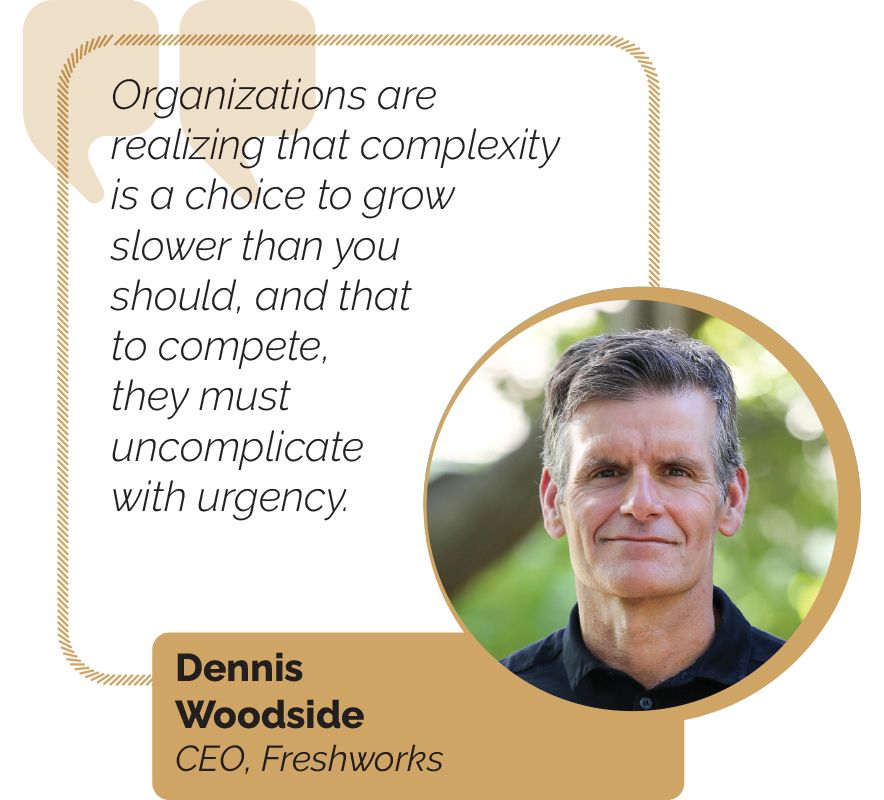
The root of the issue is not a lack of investment, but an inefficiency of application. Companies are currently wasting $1 out of every $5 spent on software due to failed implementations, underused tools, and unexpected costs. Across the U.S. economy, this aggregate friction costs nearly $1 trillion annually.
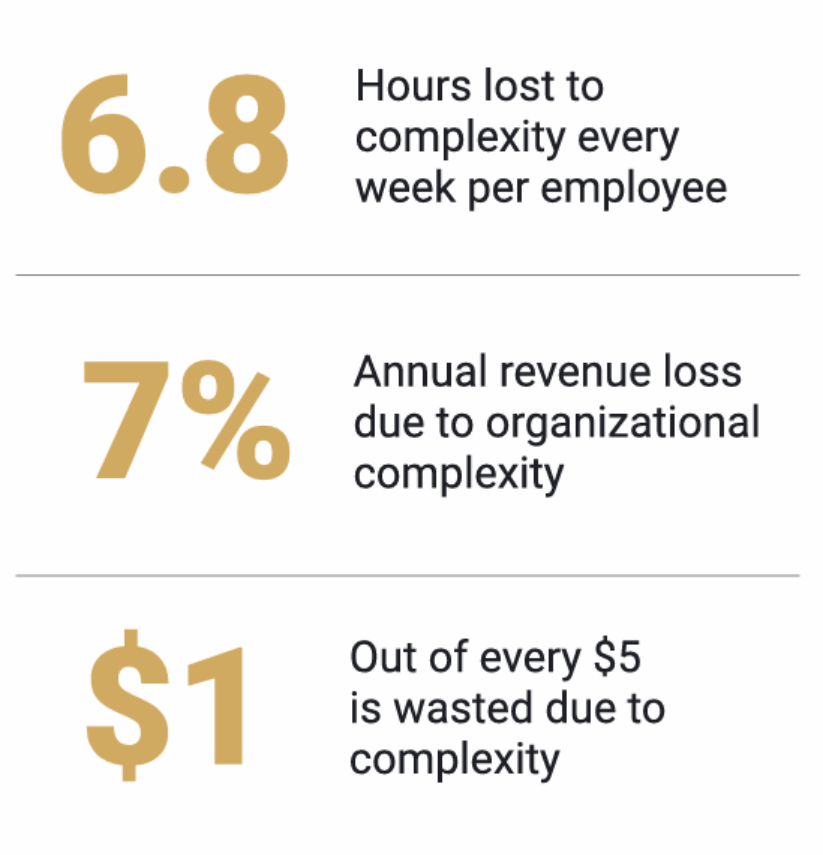
“For years, companies have been conditioned to believe complexity signals sophistication. Our research confirms what I’ve long believed—the very tools meant to help businesses move faster are now holding them back,” says Dennis Woodside, CEO of Freshworks. “Organizations are realizing that complexity is a choice to grow slower than they should and that to compete, they must uncomplicate with urgency.”
The Case of the Disappearing Friday
The financial ledger tells only half the story; the other half is written in lost time. The report identifies a productivity crisis wherein employees lose nearly seven hours every week—almost a full workday—navigating complicated processes and fragmented tools.
The average worker is now besieged by 15 different software solutions and four communication channels daily. This fragmentation creates silos, with nearly 40% of respondents noting their organization lacks a single source of truth.
For Customer Experience (CX) and IT professionals, the friction is palpable: uncustomizable workflows and the constant toggling between applications are eroding the capacity to work.
“Complexity not only erodes the employee experience, but ultimately the customer experience as well. When people spend their energy managing systems instead of relationships, every customer interaction suffers,” notes Mika Yamamoto, Chief Customer and Marketing Officer at Freshworks.
The human cost is sustainable only for so long. The research indicates a morale crisis, with 60% of surveyed employees stating they are likely to leave their organizations within the next year. Burnout is no longer just about workload; it is about workflow. Nearly one in five workers report that a colleague has quit specifically due to the stress of software implementation.
AI as an Antidote
If complexity is the disease, intelligent consolidation and an un-complicaiton of the service delivery stack appears to be the cure.
The focus is on shifting from maintenance to strategic growth. “The CIO mandate is clear: drive business growth and lead the pace of change, not just maintain systems. Yet most teams are stuck battling complexity, leading to fragmented processes and reactive practices,” says Srini Raghavan, Chief Product Officer of Freshworks.
To counter this, the company has integrated enhanced Freddy AI Agents and intelligent routing into its Freshservice platform. By allowing AI to handle the “triage”—such as surfacing real-time device telemetry to fix a slow laptop before the employee even files a ticket—organizations can reclaim that lost “Friday” of productivity.
The conclusion for the C-suite is stark. In a tightening economic environment, the competitive edge belongs to those who can remove friction. The future isn’t about who has the most software, but who has the most seamless path to their customer. Sometimes, less really can be more.