


The digital economy is often described in ethereal terms, but its physical reality is made of steel, concrete, and a voracious appetite for electricity. As the AI arms race accelerates, the construction of data centers has become the world’s most expensive industrial undertaking.
For the past decade, the “cloud” was sold as a concept of weightlessness; a place where data floated free of physical constraints. That metaphor has expired. The reality of the artificial intelligence boom is that it is terrifyingly heavy. A new report from Allianz Commercial reveals that the race to build the physical infrastructure for AI has triggered a construction bonanza of unprecedented scale, one that is reshaping risk profiles, energy markets, and the balance sheets of the world’s largest companies.
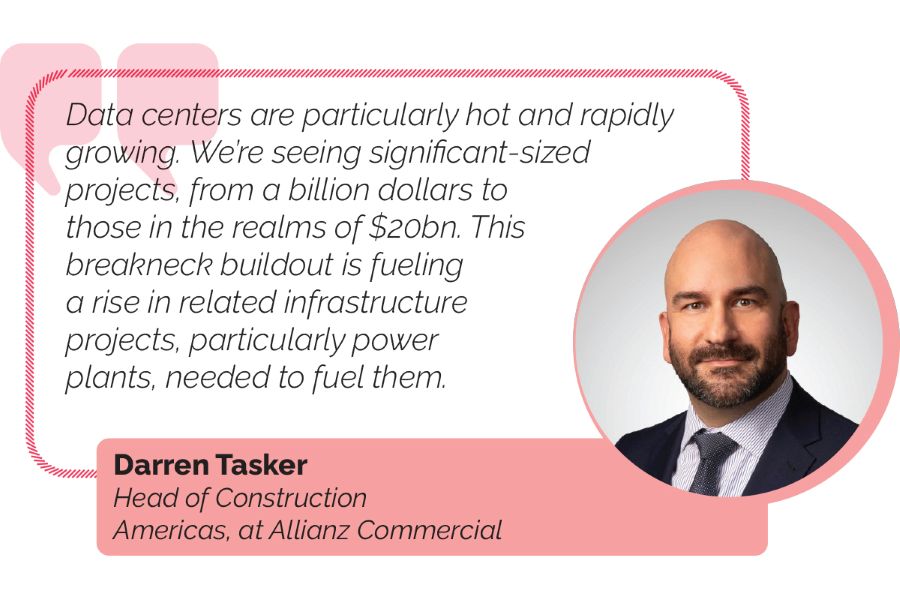
The figures are staggering. Global spending on data center construction is projected to reach nearly $3trn by 2029, with some estimates suggesting a capital outlay of up to $7trn by 2030. This is not merely a proliferation of server farms; it is a fundamental shift in industrial complexity. Where a standard facility once cost between $200m and $300m, the new generation of AI-ready “gigafactories” can command price tags exceeding $20bn per project.
Driving this expansion is a small club with deep pockets. The “hyperscalers”—Amazon, Microsoft, and Google—accounted for nearly two-thirds of global cloud revenue in early 2025. Alongside Chinese titans like Alibaba and Tencent, they are engaged in a land grab for digital sovereignty. However, as Christian Sandric of Allianz Commercial Asia notes, this expansion brings “complex and extensive risks” that demand a complete rethink of insurance and risk management.
While there are no clear signs the growth in data centers has reached its peak, there could yet be a check on the industry’s upward trajectory, according to Darren Tasker, Head of Construction, Americas, at Allianz Commercial. “Future demand for AI is difficult to gauge, due to rapid technological advances and various barriers to widescale roll-out. This has led some commentators to voice fears about a bubble, over-investment, and the prospect of stranded assets.”
The Power Paradox
The primary constraint on this growth is no longer silicon, but electrons. AI workloads are famously thirsty; a single query on a generative AI model can consume ten times the electricity of a standard web search. Consequently, global data center electricity demand is set to double by 2030, reaching levels comparable to the total consumption of Japan.
This insatiable demand is crashing against the reality of aging national grids. Facing wait times for grid connections of up to seven years in some jurisdictions, operators are being forced to go “behind the meter.” Tech giants are now effectively becoming utility companies, investing in on-site power generation ranging from gas turbines to small modular nuclear reactors (SMRs).
Fire and Water

The physical risks are equally acute. To handle the immense heat generated by high-density chips, modern facilities consume up to 19 million liters of water daily. This creates a “water stress” liability, pitting trillion-dollar companies against local communities in drought-prone regions like Mexico City and Los Angeles.
Furthermore, the densification of power increases the risk of fire. The industry’s shift toward lithium-ion batteries for backup power has introduced a new, volatile variable. As noted by Allianz experts, “thermal runaway” in these batteries can lead to fires that burn for days, causing outages that paralyze supply chains and digital services.
The Eastern Shift
While Northern Virginia remains the world’s digital capital, the center of gravity is shifting. The Asia-Pacific region is projected to grow its data center capacity at a compound annual rate of 21% through 2028, outpacing the West. With China, Japan, and India already holding 60% of the region’s capacity, the next wave of growth is set to surge through Malaysia and Indonesia.
Clearly, the days of the cloud being merely an IT concern are now behind us; it is a heavy industrial asset exposed to the very real dangers of fire, flood, and grid failure. Building the brain of the future will require a body that can survive it.