


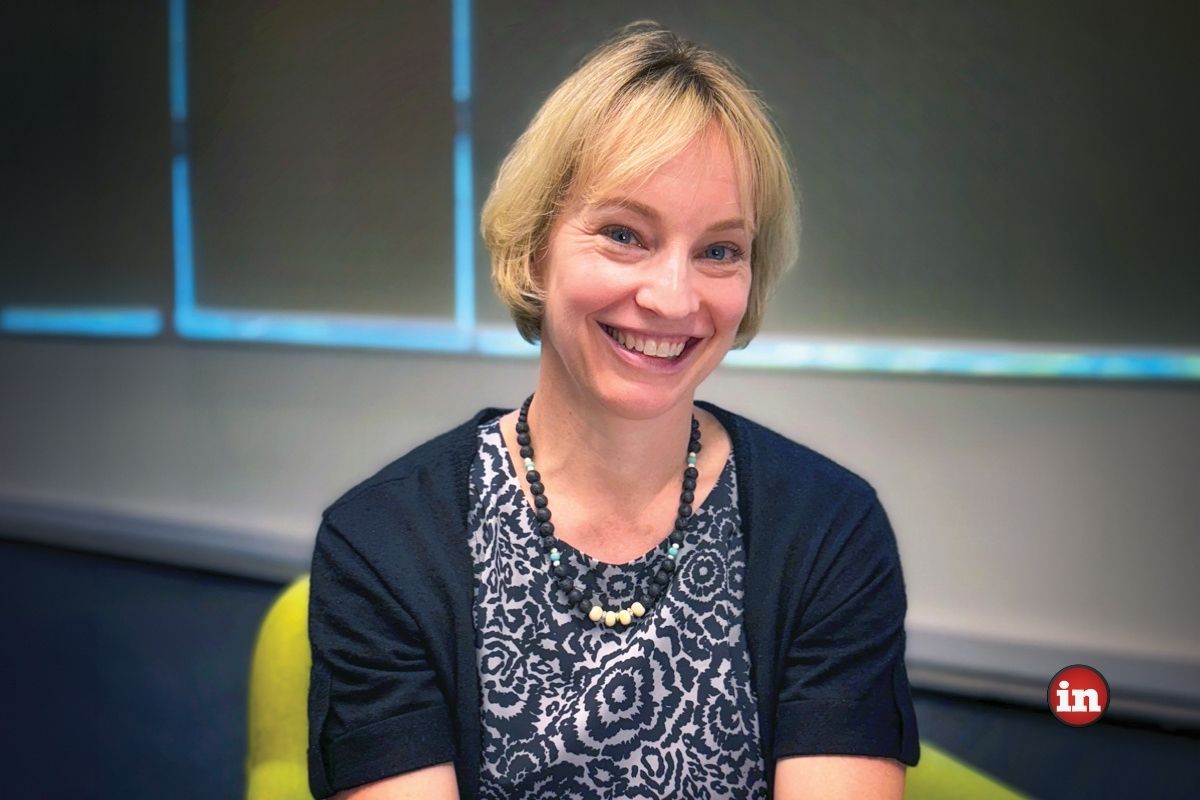
As organisations navigate hybrid work, talent wars, and rapid AI adoption, the real differentiator is not technology, but trust. In a freewheeling conversation, Libby Smith, Senior Vice President and Global Head of Human Resources at Consero Global, argues that belonging, purpose, and enablement form the foundation of resilient culture, and that geography is no longer destiny when it comes to building high-performing teams.
Words by Karan Karayi
When one speaks of the future of work, it is so often framed in binaries. Office versus remote. Human versus AI. Stability versus disruption. But speaking to Libby as we did, those binaries dissolved into something far more nuanced, and indeed far more hopeful for the future of work.
Inevitably, my opening salvo to her was on the nature of hybrid work, given that she is the spearhead maximising the potential of people spread across the globe. I wonder aloud and pose the question; just how hard is it to build a singular culture across a global workforce? And has hybrid actually leaned into rendering physical distances between offices an irrelevance?
Speaking with an affable candour that is completely disarming, she lays out how hybrid work is more than a post-pandemic experiment. It is simply an evolution whose time has come.
“Hybrid didn’t begin with Covid,” she says. “It just became more visible. What it really did was unlock access.”
Smith leads the talent function across teams in the United States, Canada, and India for Consero, which is headquartered in Austin and boasts a major presence in Bengaluru. In another era, geography might have limited leadership pathways. Today, it melts into the background as merit comes to the fore.
“If we weren’t operating hybrid, I wouldn’t be here,” she reflects. “And neither would many of the talented people we’ve been able to bring into the organisation.”
In her view, hybrid work has not fractured culture. It has democratized it. Access to leaders no longer depends on proximity to a conference room. Conversations happen over Teams, Zoom, or a quick call. Hierarchies end up softening. Visibility increases. And consequently, opportunity travels further.
“In some ways, hybrid puts everyone on the same plane,” she reflects. “It removes the idea that influence belongs to those physically in the room.”
That shift has profound implications for talent. The finance talent market, particularly in India, is intensely competitive. Salaries are important, without a doubt. But Smith is clear that compensation has become table stakes. The real differentiators lie elsewhere.
“People are asking different questions now,” she explains. “They’re not just asking what I’ll do today. They’re asking who I can become tomorrow.”
Career pathing has moved from a nice-to-have to a central expectation. Young professionals want clarity about progression. They want development opportunities, exposure, mentorship, conferences, networks. They want to understand how starting as a junior accountant might lead to becoming a controller or even a VP of Finance.
“It’s not as much about a job as much as it is about trajectory,” Smith expounds.
Flexibility, too, has evolved. It is no longer simply about working from home. It is about autonomy over when and how work gets done. “If I can’t log in from 9:00 to 5:00, but I can log in from 2:30 to 11:00 and still deliver exceptional results, that flexibility matters. It’s about trusting adults to manage their outcomes.”
And increasingly, employees expect to be seen as whole people. Wellness, identity, belonging, affiliation groups; these are not fringe concerns. They are foundational to retention and the human function.
“It’s not just about me as a professional,” Smith notes. “It’s about me as a whole person.”
This emphasis on the whole person intersects with another transformative force: artificial intelligence. The dominant narrative suggests AI is here to replace jobs. Smith rejects that framing outright.
“Let’s stop saying AI is taking people’s jobs,” she says firmly. “It’s changing how we think about skills.” She expands, outlining how transactional, repetitive tasks in accounting may become automated. But that elevates rather than diminishes the human contribution. The new premium is on logical thinking, strategic analysis, comfort with ambiguity, and the ability to synthesize information.
“We’re not hiring exactly who we would have hired five years ago,” she admits. “We’re looking for people who can interpret data, who can make decisions, who are comfortable with change.” Clearly, soft skills, once described as ancillary, are now strategic.
The modern workforce is also more complex than ever. Leaders are no longer managing only in-office teams. “You’re not just leading people or navigating hybrid employees anymore,” Smith explains. “You’re leading across different types of work and different types of contributors.” Increasingly, that is coming to include AI-driven systems and bots. That requires a new managerial muscle; one that is grounded not just in technical expertise, but in adaptability, empathy, and systems thinking.
Yet for all the conversation about technology and flexibility, Smith keeps returning to one word: engagement.
When asked how to build a culture that protects against burnout in a deadline-driven industry like finance, she reframes the discussion. “I think about culture through engagement,” she says. “If you get engagement right, culture follows.”
She paints a picture of it as a three-legged stool.
The first leg, she explains, is belonging. Do employees feel seen, heard, and appreciated for who they are? Do the organisation’s core values resonate with them? Do they feel safe bringing their full selves to work?
The second is purpose. Can they clearly see how their individual contribution ties to broader business outcomes? Can they connect their daily work to the company’s success?
“If I understand how what I do impacts the bottom line or supports our clients, I’m more likely to opt in,” she says.
The third prong is enablement. Do employees have the tools, clarity, and operating models they need to succeed? Technology. Role definition. Clear expectations.
“If you get those three things right,” she reflects, “you create the foundation for a strong culture.”
She was quick to underline the decoupling of these key factors from geography, stating with a smile, “You’ll notice none of that relies on where I work.”
In an era obsessed with physical offices versus remote mandates, Smith’s framework feels refreshingly grounded and honest to today’s reality. Culture is not a building. It is not an edict, it is not a doctrine. It is about something more meaningful. Belonging. Purpose. Enablement. Clearly, the connective tissue of an organisation is not proximity. It is shared meaning.
The future of work will continue to evolve. AI will doubtlessly accelerate exponentially, generational expectations will shift, and hybrid will become the norm rather than the exception. In that milieu, leaders face a choice. They can chase trends. Or they can double down on the fundamentals of human engagement.
Libby Smith is clearly betting on the latter.
The future of work, she suggests, will not be defined by how many days employees spend in the office or how many tasks AI can automate. It will be defined by whether organisations can create environments where people feel valued, empowered, and prepared for what comes next.
And in a world of rapid change, that may be the most enduring strategy of all.