



Senior Advisor and Project Head, Climate Adaptation,
Resilience and Climate Finance in Rural India (CAFRI),
GIZ India.
Climate change is reshaping the world in visible and disruptive ways. Unpredictable weather patterns, shifting temperatures, erratic rainfall, groundwater depletion, floods and prolonged dry spells are affecting water availability. As a consequence, lives are threatened, infrastructure is damaged, and agriculture, the backbone of many economies, is destabilised. These disruptions not only harm livelihoods but also undermine years of development investments. As climate impacts are often highly region-specific, effective responses must be rooted in local realities, guided by strong community participation and supported by local governance systems.

This understanding has given rise to the growing importance of locally led adaptation and disaster risk reduction. Unlike traditional top-down approaches, this paradigm empowers communities and grassroots actors to determine when, where, and how climate solutions are applied.
Bridging the Policy-Practice Gap
In India, the National Action Plan on Climate Change (NAPCC) along with its sectoral and regional focus missions as well as the State Action Plans on Climate Change (SAPCCs) serve as the primary vehicles for advancing adaptation at the subnational level. They ensure alignment with national priorities outlined in the country’s Nationally Determined Contributions (NDCs). While strong national policies exist, the real test lies in translating them into resilient practices on the ground.
Bridging this gap requires governance models that connect national frameworks with grassroots innovation. Collaborative climate governance models where communities, governments, and the private sector work hand in hand, are emerging as a powerful approach to strengthen resilience.
The Deutsche Gesellschaft für Internationale Zusammenarbeit (GIZ) GmbH on behalf of the Federal Ministry for Economic Cooperation and Development (BMZ) has been demonstrating these collaborative governance models through Locally Led Adaptation (LLA). LLA brings together ministries, such as the Indian Ministry of Environment, Forest and Climate Change (MoEFCC), sectoral ministries such as the Ministry of Agriculture, along with state agencies, local government institutions, the National Bank for Agriculture and Rural Development (NABARD), farmer producer organisations (FPOs), NGOs, academia, and the private sector. These frameworks move beyond fragmented interventions to ensure that climate policies translate into co-owned strategies for resilience.
Around the world, and increasingly in India, these models are moving from policy discussions to on-the-ground practice, offering valuable lessons for building a climate-resilient future. These governance models have demonstrated how multi-stakeholder frameworks can accelerate climate targets by linking policy, private sector action, and grassroots participation.
Locally Led Adaptation: A Global Shift
The heart of climate governance lies in empowering those most affected. Women farmers, smallholders, and marginalised groups are not passive recipients but active co-creators of climate adaptation solutions.
The idea of LLA emphasises the leadership of communities and local institutions in determining how, where, and when climate solutions should be implemented. Internationally, this paradigm shift is shaping disaster risk reduction and adaptation strategies by prioritising local knowledge, participation, and ownership.
In India, frameworks like the NAPCC and SAPCCs set the direction. Yet, the real challenge lies in ensuring these plans influence everyday development decisions at the village level. Gram Panchayats, constitutionally mandated as self-governing village bodies, provide an ideal entry point. By integrating climate concerns into Gram Panchayat Development Plans (GPDPs), Panchayats can embed resilience and risk reduction into the fabric of local governance.

Photo: Vulnerability mapping of Raheli – Vishunpur, Shravasti District, Uttar Pradesh; © GIZ India
Climate Governance in Practice: The Uttar Pradesh Model
The ultimate test of governance lies in measurable outcomes. Uttar Pradesh, India’s most populous state, demonstrates how global frameworks can translate into local action. The state government, with support from GIZ in India, identified 39 climate-vulnerable Gram Panchayats across nine agro-climatic zones. These assessments laid the foundation for risk-informed GPDPs, designed through community participation.
In the Rehali-Vishunpur Panchayat of the Shravasti district, frequent floods and prolonged waterlogging had long damaged crops, homes, and public assets. Through participatory planning, villagers prioritised interventions such as elevated hand pumps to avoid flood damage, constructing drainage systems, rejuvenating ponds, planting trees, and managing waste. By embedding these actions into the GPDP, climate resilience became part of mainstream development rather than an add-on.
Panchayat-Private Partnerships: Leveraging Resources
Public financing alone cannot meet the scale of raising climate challenges. Recognising this, the state of Uttar Pradesh pioneered Panchayat–Private Partnerships (PPPs), which channelled corporate social responsibility (CSR) funds of organisations and philanthropic grants into climate action at the village level.
Under this model, corporates collaborated with the Government of Uttar Pradesh to co-design and fund projects for Panchayats for risk informed development. Among others, the key activities implemented through the PPPs included restoring ponds and improving groundwater recharge, install mini solar grids and promoting clean cooking, developing plastic-free villages and supporting natural farming and strengthening market linkages.
The 39 identified Gram Panchayats have pioneered risk-informed GPDPs, demonstrating how public–private partnerships can successfully mobilise corporate capital and expertise, channel CSR commitments, and transform local planning into resilient, resource-backed action.
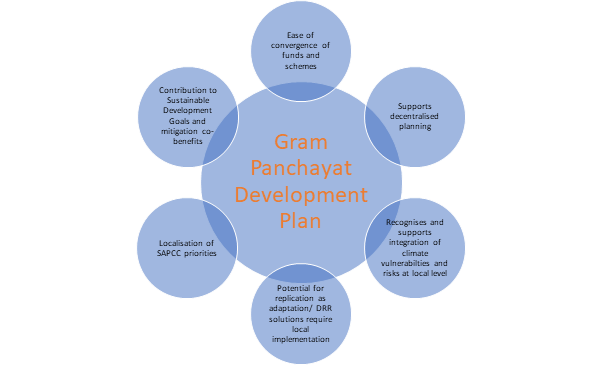
Graphic: Risk-informed GPDP model; © GIZ India
Inclusive and Gender-Responsive Planning
The effects of climate change are not equally felt. Women, marginalised groups, and poor households often face the greatest risks. Recognising this, the GPDP framework in Uttar Pradesh emphasises inclusive participation. Women and vulnerable groups are engaged in planning processes to ensure that their perspectives influence priorities and resource allocations.
By mainstreaming gender considerations, Panchayats are not only advancing climate resilience, but also contributing to Sustainable Development Goal (SDG) 5 on gender equality.
Building Local Capacity
Effective collaborative governance requires strong local capacities. Uttar Pradesh has invested in building the skills of Panchayati Raj Institution (PRI) functionaries through e-learning platforms, toolkits, and peer-learning networks. State institutions such as the State Institute of Rural Development (SIRD) are developing a cadre of trained facilitators to scale these approaches across more villages.
Linking local initiatives with national programmes such as Mission LiFE and the Green Credit Programme ensures that grassroots efforts also contribute to India’s international commitments.
Learnings and Insights
Uttar Pradesh’s experience offers several key lessons for climate governance models:
- Empower Panchayats: Enabling village institutions to integrate climate risk into development planning ensures ownership and sustainability.
- Mobilise PPPs: Leveraging private sector resources and innovation expands the reach and scale of local climate action.
- Institutionalise participation: Ensuring women, youth, and marginalised groups have a voice in planning strengthens social equity.
- Converge resources: Pooling government schemes, CSR contributions, and international support maximises impact.
- Invest in capacity: Building local leadership is essential for scaling and sustaining action.
By weaving together policy intent, private innovation, and grassroots action, these governance models make climate targets tangible, scalable, and inclusive.
Conclusion
As India navigates the twin challenges of climate change and rural development, the shift from policy to practice is crucial.
Collaborative governance models, such as those facilitated by GIZ in the fields of agriculture and water, provide a compelling blueprint. Initiatives such as risk-informed GPDPs in Rehali-Vishunpur, Uttar Pradesh, showcase how collaborative, inclusive, and participatory governance can convert national commitments into tangible action. They show that climate resilience is not about isolated projects but about building systems where government, private sector, and communities co-create solutions.
The journey ahead will require more such alliances that move beyond funding to shared responsibility and co-shaped pathways, ensuring that climate adaptation in rural India is not only effective but also equitable1.
Authors:
Kirtiman Awasthi, Senior Advisor and Project Head, Climate Adaptation, Resilience and Climate Finance in Rural India (CAFRI), GIZ India.
Manas Dwivedi, Advisor, Climate Adaptation, Resilience and Climate Finance in Rural India (CAFRI), GIZ India.
Disclaimer: This article reflects the personal opinion of the authors.
[1] Enhancing climate resilience in rural India – giz.de