


The 2025 verdict is in. Artificial Intelligence has not replaced the workforce, but it has irrevocably fractured it. A new divide, defined not by geography or industry, but by daily algorithmic engagement, is creating a class of “super-users” who are earning more, working less, and leaving their colleagues behind
For three years, the global workforce has held its collective breath. Since the generative AI explosion of late 2022, the prevailing anxiety was singular: displacement. The fear was that machines would render human labor obsolete. But as we approach the end of 2025, PwC’s Global Workforce Hopes and Fears Survey reveals a reality that is more nuanced and, in many ways, more challenging for leadership to navigate. The machine has not replaced the human; it has amplified a select few.
The survey, a massive undertaking involving nearly 50,000 workers across 48 major economies, paints a picture of a global labor market that is stabilizing but deeply stratified. The headline finding is the emergence of the “Daily Dividend.” While only 14% of the global workforce uses generative AI (GenAI) daily—a marginal rise from 12% in 2024—this small cohort has effectively seceded from the struggles of the general population.
The Super-User Secession
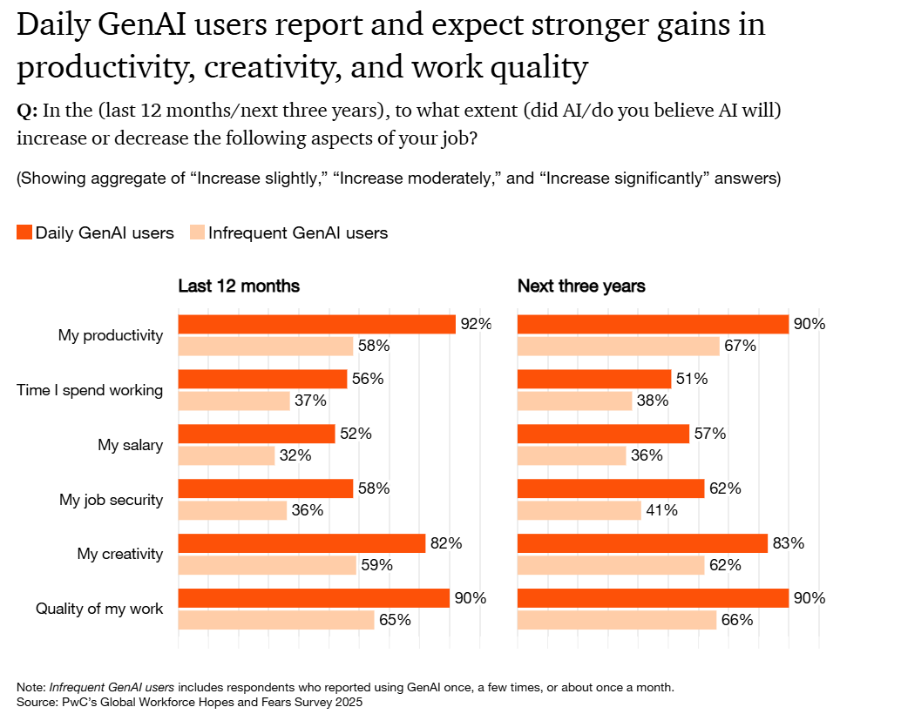
For the “daily user,” the AI promise has been kept. The data is unequivocal: 92% of workers who use GenAI daily report higher productivity, compared to just 58% of infrequent users. Even more critically, this productivity is translating into tangible economic mobility. Over half (52%) of daily users report seeing an increase in their salary, compared to 32% of those who rarely touch the technology.
This creates a profound strategic dilemma. For the past two years, C-suite leaders have focused on “democratizing” AI, rolling out broad access and general training. Yet, usage remains stubbornly low. With 54% of workers having used AI at least once in the past year but only 14% integrating it into their daily rhythm, the gap between “access” and “adoption” has widened.
The 14% are not just working faster; they are feeling safer. In a year marked by economic volatility, 58% of daily users report feeling greater job security, compared to 36% of infrequent users. They have crossed the chasm. For them, AI is no longer a threat to be managed, but a lever to be pulled. They are 69% more optimistic about the future of their roles than their peers.
The Overwhelmed Majority

If the view from the top is bright, the view from the middle is increasingly bleak. The survey exposes a workforce that is running on fumes. Financial strain has intensified, with 55% of employees reporting significant financial stress, up from 52% in 2024.
This economic pressure is compounded by a pervasive sense of exhaustion. More than one-third (35%) of the global workforce reports feeling overwhelmed at least once a week. For Generation Z—the demographic most expected to champion digital transformation—that figure rises to 42%.
The social contract of the workplace appears to be fraying. Despite the inflationary pressures of 2025, fewer than half of workers (43%) received a pay rise in the last year, and only 17% received a promotion. The “Great Resignation” has been replaced by the “Great Stagnation.” Intent to seek a pay rise has fallen from 43% to 37% year-on-year. Workers are not quitting; they are hunkering down, trapped between rising costs and stagnant wages, watching a small minority of AI-enabled peers accelerate away from them.
The Trust Deficit
This bifurcation is fueling a crisis of trust. Only 64% of employees say they understand their organization’s goals, a figure that drops precipitously among non-managers and younger workers. The message from the C-suite—”AI will save us”—is landing on skeptical ears.
The disconnect is exacerbated by an uneven playing field in Learning and Development (L&D). The survey highlights a “wealth begets wealth” dynamic in skills acquisition. Daily AI users—already more productive and better paid—are also receiving the lion’s share of corporate investment. 75% of daily users say they have access to the L&D resources they need, compared to just 59% of infrequent users.
“Based on current trends, those who are already using AI look set to extend their lead over the rest of the workforce,” the report warns. The corporate training infrastructure, inadvertently or otherwise, is compounding the advantage of the tech-savvy elite while failing to lift the overwhelmed majority.
The Agentic Frontier
Looming over this divided landscape is the next technological wave: Agentic AI. These are not the chatbots of 2023 that wait for a prompt; these are autonomous agents capable of reasoning, planning, and executing complex workflows.

Adoption is currently nascent, with only 6% of the workforce using agentic AI on a daily basis. However, the implications are staggering. If GenAI created a productivity gap, Agentic AI threatens to create a capability canyon. An employee backed by a fleet of autonomous agents can theoretically perform the work of an entire department.
The risk for 2026 is that companies will deploy these agents to replace the “overwhelmed majority” rather than support them. This would be a strategic error. As Pete Brown, PwC’s Global Workforce Leader, argues, “Work itself needs to be redesigned and the human–machine partnership redefined. Getting this right will determine whether GenAI becomes a true engine of growth and inclusion, or a missed opportunity”.
The Leadership Mandate
The 2025 Hopes and Fears survey is not a scorecard of technology; it is a barometer of leadership. The data suggests that the “deploy and pray” strategy of giving everyone a ChatGPT license and hoping for the best has failed.
To bridge the Daily Divide, leaders must shift from “access” to “redesign.” It is not enough to provide the tool; the workflow itself must be dismantled and rebuilt to accommodate the tool. The 45% of workers who report that their workload has increased significantly need AI to offload drudgery, not add a new layer of complexity.
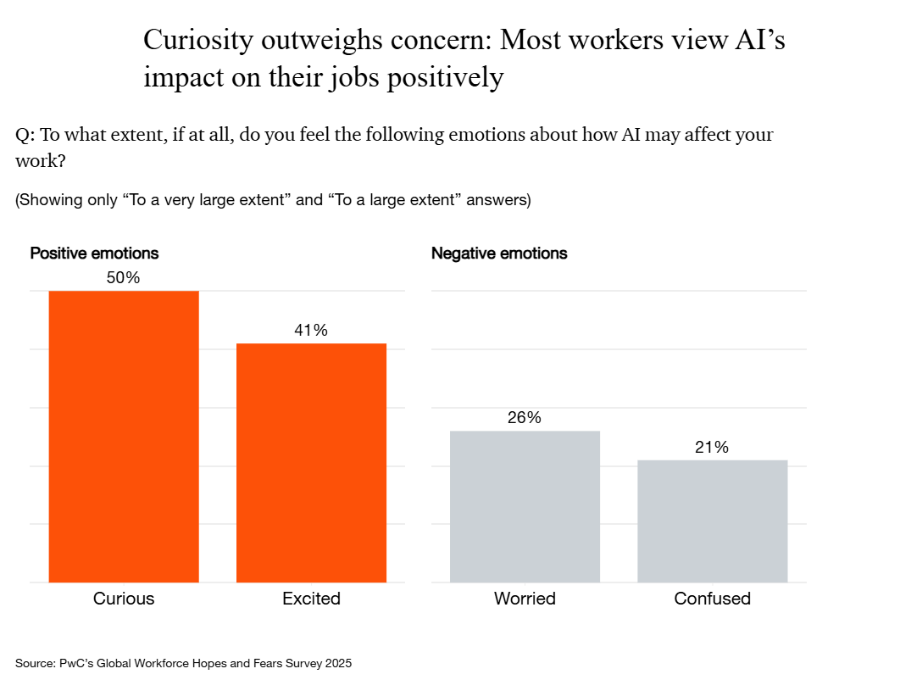
Furthermore, the “Trust Gap” must be addressed with radical transparency. If employees believe that AI is a tool for the 14% to become super-productive while the 86% are managed out, resistance will harden.
The future described in the 2025 report is one of immense potential but fragile cohesion. We have built a Ferrari engine and installed it in a Model T chassis. The engine (namely AI) is working perfectly for the few who know how to wring the most out of it. For everyone else, the ride is shaking them apart. The task for 2026 is not to build a faster engine, but to build a vehicle that can carry the whole workforce forward.