


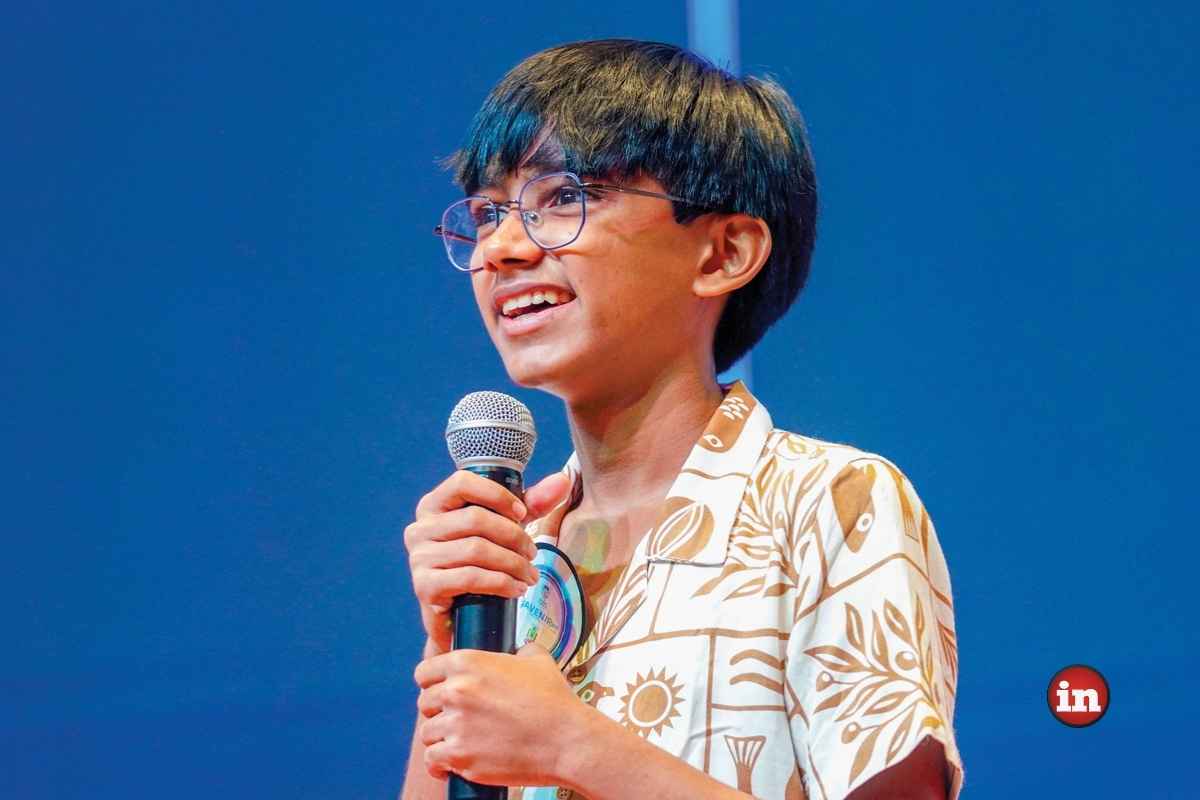
We catch up with India’s youngest AI builder on curiosity, impact, and education
Raul John Aju did not set out to build a movement. He set out to edit videos faster. That small act of curiosity, of asking how something was possible and then refusing to stop at the answer, became the thread that led him from content creation to robotics, from AI tools to legal access platforms, and from a teenage founder to one of India’s most compelling young voices on technology and its human stakes. Below are excerpts from a conversation about what it means to build with purpose.
You built your first robot at 12, founded a company at 16, and are already advising governments on AI. At what point did you realise this was no longer just a hobby, but something much bigger?
It was never about building something big in the beginning. It started with curiosity and trying to solve small problems in my own life. I was creating content and struggling to balance everything with studies. So I searched for ways to edit videos faster. That’s when I found a tool that could do in a couple of days what used to take me weeks. That moment genuinely changed everything for me. I kept thinking, how is this even possible?
That question pulled me into exploring more. Slowly I realised this is not just a tool, this is leverage. It changes how much one person can do. But the real shift happened when I started sharing it. I saw how people reacted when they discovered these things for the first time. That’s when it stopped being curiosity and became something much bigger.
It became about impact.
You’ve been vocal about India needing to lead its own AI race rather than follow others. What would that leadership actually look like, and what is holding India back right now?
For me, leadership is not about copying what others are doing faster. It is about building what only we can build. India has unique challenges, but those challenges are actually opportunities.
Language diversity, accessibility, affordability, scale. If we solve problems in these areas, we can create solutions that the rest of the world can learn from. Right now the limitation is not talent. It is alignment. Builders do not always get the right support. Education does not always encourage experimentation. There is a gap between ideas and execution. Once we start focusing on building real solutions and encouraging people to experiment, we will not just catch up. We will define the
future in our own way.
Your tools like Project 47X and ThinkCraft Academy are focused on real-world problems, from legal access to AI education. How do you decide which problems are worth solving?
Most of the problems I work on come from real life. If something feels confusing, broken, or difficult for a lot of people, that’s where I start paying attention. I am less interested in building something that looks impressive and more interested in building something that is actually useful. A problem is worth solving if it can genuinely help someone move forward. If it saves time, reduces confusion, or gives access to something that was previously hard, it matters. That mindset has shaped
everything I build, whether it is in education, legal access, or automation.
You’ve spoken about the most important skill in an AI world being the ability to stay deeply human. What do you mean by that, and why does it matter?
Technology is getting extremely powerful. It can generate, automate, and optimise faster than ever before. But it still does not understand intention, emotion, or meaning the way humans do. That is where the real value lies. Staying human means keeping curiosity, empathy, and the ability to question things. It means not blindly accepting outputs but thinking about why something matters.
For me, impact matters the most. When someone tells me they started building something or changed their direction because of what I shared, that is what stays with me. In a world full of answers, the real skill is knowing what to ask.
India’s education system has been a recurring theme in your conversations. If you could change one thing about how young people in this country are taught to think, what would it be?
I would shift the focus from memorising answers to asking better questions. Students today are trained to be correct, but not always to be curious. They follow systems but do not always explore ideas. The future belongs to people who can think independently, experiment, and figure things out. If we build an environment where students are encouraged to try, fail, and learn, we will create a generation that does not just follow the future but builds it.