




Words by Sauvik Dey and Meghana Kshirsagar
Every morning in the summer, Mohan1 wakes up with a foreboding thought that sparks a calculation not immediately reflected in the balance sheets. As a construction site supervisor, he estimates the loss of productive working hours today due to heat. Last season it was 30 percent. When he started as an apprentice a decade ago, work went on all day but now it pauses by noon.
Mohan’s dilemma captures a larger economic reality that India Inc is starting to confront with uncomfortable clarity. Summers have stretched over transition seasons and intensified beyond convenience. It is a structural constraint, which is diluting our developmental and economic gains, in the form of lost labour hours, strained infrastructure, and escalating operational costs.
As per estimates from the Lancet Countdown India 2024, 181 billion potential labour hours were lost in 2023 alone, amounting to 141 billion in potential income losses. The Reserve Bank of India underscores that up to 4.5 percent of Gross Domestic Product (GDP) could be at risk by the end of the decade due to lost labour hours from extreme heat and humidity.
The Multiplication Effect
India has always experienced hot summers, but with humidity also increasing, the Wet Bulb Globe Temperature (WBGT)2 turns fatal even at lower temperatures. For every degree rise, labour productivity can decline by approximately 2-3 percent, depending on task intensity3. India’s workforce has an amplified exposure, with nearly 90 percent employed in the informal sector. Informal workers lack access to workplace cooling, paid leave, or protection mechanisms. For people working in construction, farms, or manufacturing, it leads to shortened working hours, less productivity in hours operated, and thereby contracting output.

Extreme heat stress intensifies prevalent conditions, such as cardiovascular diseases, respiratory illness, kidney failure, and diabetes5. For India’s urban poor, elderly populations, pregnant women, and individuals with chronic diseases, each additional degree adds to existing vulnerabilities. The National Programme on Climate Change and Human Health (NPCCHH) has strengthened emergency cooling protocols but during heat events, the systemic demand continues escalating.
The Cost of Heat in Business
For companies, rising heat is no longer a sole environmental issue. Higher energy consumption raises operating expenses, while declining worker efficiency slows production. As a result, extreme heat is increasingly influencing investment decisions and risk assessments. The World Bank and International Monetary Fund (IMF) have both identified extreme heat as a growing macroeconomic risk, particularly for emerging economies with heat-exposed infrastructure6. For India, several assessments project that unaddressed heat stress could potentially reduce the GDP by 5 percent or more annually by the end of this decade7.
Energy consumption fluctuates in response to the rising heat, with the country’s peak demand reaching 250 GW in May 2024, straining grid infrastructure to its limits. It is projected that peak demand could reach 277 GW by FY 20268. This means increased coal imports to 42.79 million tons, 23.8 percent year-on-year.
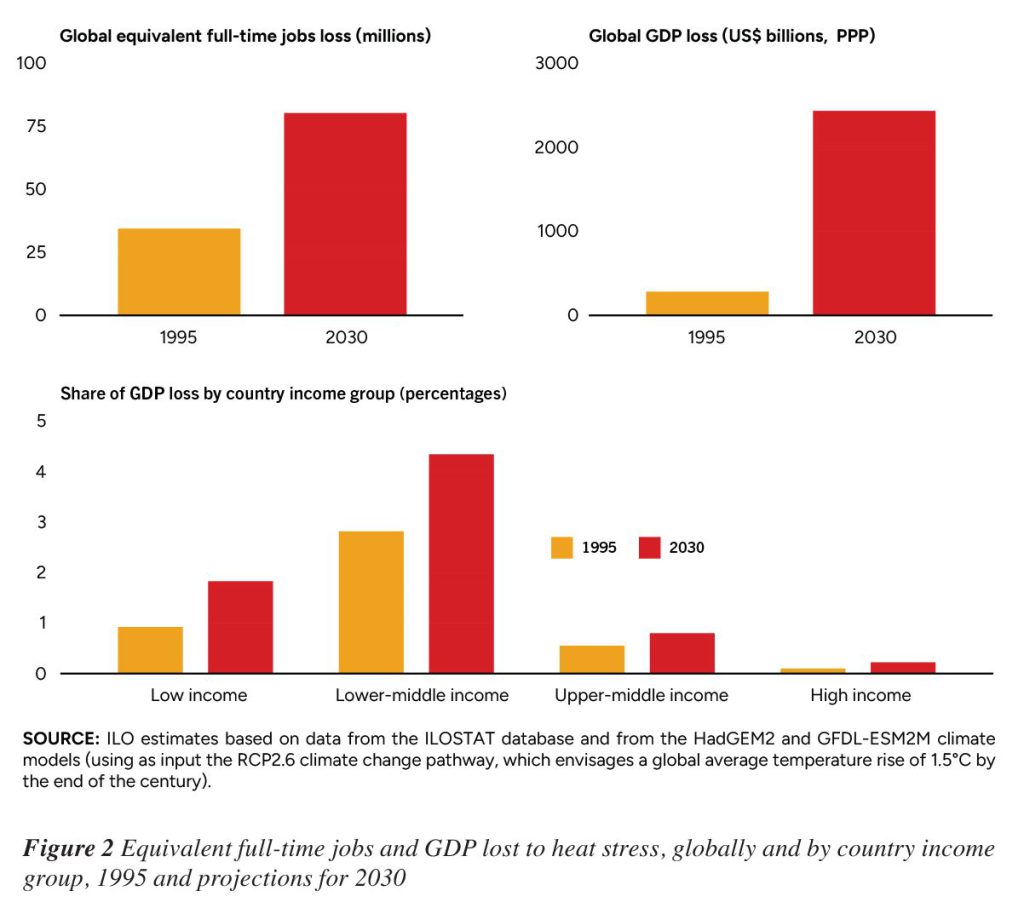
The most heat exposed sectors, including construction, manufacturing, mining, agriculture, and logistics represent a substantial portion of India’s economic base, and their impact is pronounced in investor ESG (Environmental, social, and governance) ratings, and underwriting, adding more layers to adapt to.
This reality reframes Corporate Social Responsibility (CSR) engagement with heat resilience, contributing towards workforce wellbeing, sustainability, and long-term business continuity. The World Economic Forum and the Global Goal on Adaptation underscore that adaptation is a material business risk that requires private sector engagement, investment, and operational changes. Moving forward, improving access to cooling, building resilient urban infrastructure, and more, would go beyond merely meeting compliance or ESG expectations. They would actively safeguard productivity, and supply chains in a warming world.
Building resilience with the 45-degree burden
Back at his construction site, Mohan works with a modified schedule. Work starts at 5:30 a.m. until 11:30 a.m., then it pauses, resuming back again at 4 p.m. It is a compromise that keeps daily output at around 75%. Building new project timelines is essential as old models do not work any longer. Adaptation is a binary choice.
Reducing the heat tax requires consideration of extreme heat as an economic and social challenge. As India aims to transition towards a sustainable lifestyle by lowering emissions, increasing energy efficiency, strengthening climate resilient urban design, and expanding green cover, the economics of 45°C reveal a considerable hindrance. Addressing this challenge demands heat resilience models, protection of vulnerable workers, and a decisive shift towards sustainable lifestyles. Sustaining livelihoods in a warming India will increasingly depend on the resilience of people, infrastructure, and the systems that support them from workplaces and housing to health services. The choices we make today will shape whether extreme heat remains a growing economic penalty or becomes a manageable challenge.
Taking cognisance of challenges of our hotter reality, a concentrated effort towards heatwave preparedness, response, and risk reduction, is needed; to arrest human, ecological, and business impacts. Against this context, the Deutsche Gesellschaft für Internationale Zusammenarbeit (GIZ) GmbH, on behalf of the Federal Ministry for Economic Cooperation and Development (BMZ), is implementing the Indo-German Cooperation Project ‘Integrated Climate Risk Management in India (InCRIS)’. In close cooperation with the National Disaster Management Authority (NDMA) under the Ministry of Home Affairs (MHA), Government of India, GIZ India works on strengthening India’s approach to heat stress and heatwave management. The project will develop interventions on enhancing institutional coordination, community-level outreach, and integration of financial and risk-transfer solutions to address heat-related losses.
The central pivot is not to ascertain whether we can afford to invest in heat resilience, but rather can we afford not to. We need coordinated action across government, business, and civil society for every degree of inactions, takes us towards stalemate.
The authors are Sauvik Dey (Advisor) and Meghana Kshirsagar (Project Manager)
Integrated Climate Risk Management in India (InCRIS)
Environment, Climate Change, and Natural Resource Management
Deutsche Gesellschaft für Internationale Zusammenarbeit (giz) GmbH
Disclaimer: This article reflects the personal opinion of the author(s).
Sources
- Lancet Countdown India (2024), Heat exposure resulted in 181 billion potential labor hours lost in 2023. URL: https://www.thelancet.com/countdown-health-climate
- Reserve Bank of India (2024) Up to 4.5% of GDP at risk by 2030 from heat-induced labor productivity losses, Referenced in: https://ddnews.gov.in/en/heatwaves-could-adversely-affect-indias-economic-growth/
- International Labour Organization (2019). Working on a Warmer Planet: The impact of heat stress on labour productivity and decent work, URL: https://www.ilo.org/sites/default/files/wcmsp5/groups/public/%40dgreports/%40dcomm/%40publ/documents/publication/wcms_711919.pdf
- Kjellstrom, T., Briggs, D., Freyberg, C., Lemke, B., Otto, M. and Hyatt, O. (2016), Heat, human performance, and occupational health: a key issue for the assessment of global climate change impacts. *Annual Review of Public Health*, 37, pp.97-112.
- International Labour Organization (2018), Women and men in the informal economy: A statistical picture. Third edition.
- Isaac, T. et al. (2025), Productivity losses from heat exposure in Indian outdoor workers. *Environmental Research*, 276, 121495.
- Council on Energy, Environment and Water (CEEW) (2025), How Extreme Heat is Impacting India: Assessing District-Level Heat Risk. 76% of India’s population at high to very high heat risk. URL: https://heathealth.info/news/double-trouble-two-new-reports-highlight-large-scale-climate-change-impact-on-the-indian-population/
- Burke, M., Hsiang, S.M. and Miguel, E. (2015). Global non-linear effect of temperature on economic production. *Nature*, 527(7577), pp.235-239.
- World Bank (2023). India: Helping People Build Resilience to Climate Change. URL: https://www.worldbank.org/en/country/india/brief/advancing-climate-adaptation-building-resilience-to-climate-change-in-india
- International Monetary Fund (2025), Integrating Climate Change into Macroeconomic Analysis: A Review of Impact Channels, Data, Models, and Scenarios. IMF Working Paper WP/25/170.
- World Health Organization (2024), Climate change, heat and health – Fact sheet. URL: https://www.who.int/news-room/fact-sheets/detail/climate-change-heat-and-health
- McKinsey Global Institute (2020) Will India get too hot to work? Estimated $250 billion or 4.5% GDP loss by 2030 from heat-related labor productivity decline, URL: https://www.mckinsey.com/capabilities/sustainability/our-insights/climate-risk-and-response-physical-hazards-and-socioeconomic-impacts
- Ministry of Power, Government of India (2024), Year End Review 2024. Record power demand of 250 GW met in FY 2024-25. URL: https://www.pib.gov.in/PressReleasePage.aspx?PRID=2089243
- India Brand Equity Foundation (IBEF) (2025), Power Sector in India: Trends in Electricity Generation. Peak demand projected at 277 GW by FY26. URL: https://www.ibef.org/industry/power-sector-india
- National Disaster Management Authority, India (2019), National Guidelines for Preparation of Action Plan – Prevention and Management of Heat Wave. URL: https://nidm.gov.in/PDF/pubs/NDMA/27.pdf
- UNICEF (2024), Extreme heat-related school disruptions affected hundreds of millions globally. Referenced in: https://www.policycircle.org/environment/extreme-heat-productivity-loss/