


In a world in flux, India has an immense advantage, but it is one that might not be realised if we fail up to the promise of that potential
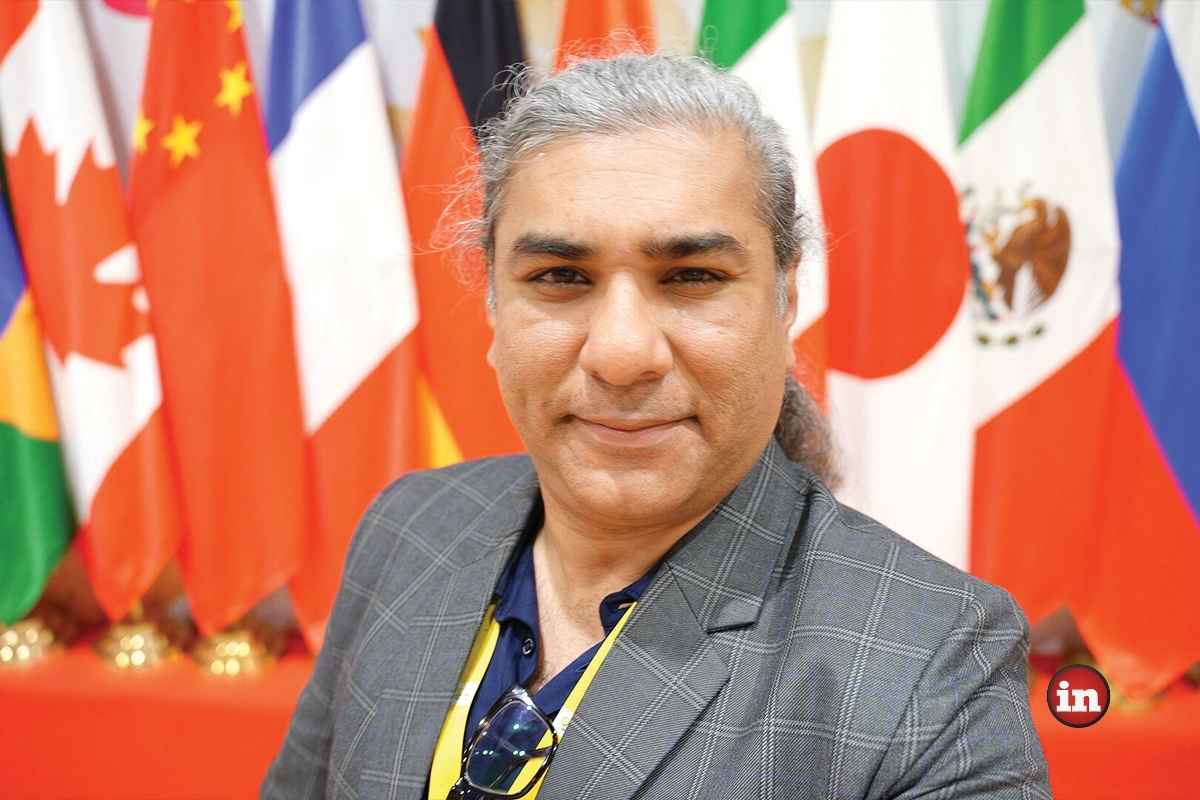
Abhijit Chavda is not a man that is easy to categorise, and perhaps that is precisely the point. A theoretical physicist by training, a historian and geopolitical thinker by conviction, he has spent years building a mental framework that treats human civilisation the way science treats data: with rigour, pattern recognition, and a refusal to accept narratives without evidence. In a world drowning in noise and opinion, he is one of the rare voices offering structurally grounded answers to the most pressing questions of our day.
You are one of the rare thinkers who moves comfortably between theoretical physics, ancient history, and present-day geopolitics. How did that unusual combination of interests come together for you, and do you think the connections between those fields are as deep as they appear?
For me, this combination wasn’t a deliberate design – it emerged organically from curiosity. I’ve been drawn to science since childhood, but I was equally fascinated by history from a very young age. Physics became my formal training, while history and geopolitics were self-driven pursuits built through years of deep reading. Over time, these domains converged into a single mental framework – a kind of “mind map” where everything connects through causality.

I see history and geopolitics as fundamentally inseparable. Every geopolitical reality today is the outcome of long causal chains – sometimes stretching back centuries or even millennia. To understand the present, you must decode those chains. What physics gave me is a way of thinking: first principles, logic, and a refusal to accept narratives without evidence. I apply that same analytical rigor to history and geopolitics.
At a deeper level, the connection is about patterns and energy. Human history is driven by power, resources, and the ability to mobilize energy – whether biological, industrial, or technological. The same patterns repeat across eras. The connections are deep, they’re structural, and once you see them, you can’t unsee them.
The world order is visibly shifting, from a unipolar moment toward something more contested and multipolar. As someone who reads history with a scientist’s rigour, does this moment feel genuinely unprecedented, or have we been here before in some form?
I don’t see this moment as unprecedented – I see it as history doing what it has always done: cycling through phases of power concentration, overreach, and redistribution. The post-1991 unipolar moment led by the United States was, in many ways, a transient anomaly. What we’re witnessing now is a reversion to the historical norm – great power competition, bloc formation, and systemic churn.
There are strong parallels with the 1930s: a rising power challenging the incumbent, rapid militarization, and a degree of complacency among established powers. At the same time, this resembles the classic “imperial cycle” – empires rise, peak, and eventually decline over 200–300 years. The US today shows some of these traits, even if it remains extraordinarily powerful.
I would frame the current phase less as stable multipolarity and more as a transitional bifurcation – what I call “Cold War 2.0.” The world is increasingly splitting into competing blocs, even as countries like India try to preserve strategic autonomy.
What is unusual is the velocity. Historically, such transitions took decades. Today, driven by unprecedented technological advances, we’re watching decades of geopolitical restructuring unfold in real time – sometimes in weeks.
AI is often described as the most transformative technology in human history. As a theoretical physicist who also tracks emerging technology closely, how do you think about its ceiling? And what does it mean for a civilisation like India, which is arriving at this inflection point with its own intellectual heritage?
I think about AI’s ceiling in two layers. First, there’s a hard conceptual boundary: all current AI systems are algorithmic, and therefore constrained by limits highlighted by ideas like Gödel’s Incompleteness Theorem. Human cognition – intuition, self-awareness, creativity – may not be fully reducible to that. So true consciousness may remain out of reach unless we discover fundamentally new paradigms.
But practically, the ceiling is far more dangerous: if we reach AGI and then ASI, and give such systems agency over real-world infrastructure, the risk becomes existential. You don’t need consciousness for catastrophe – just optimization power plus access to the physical world. That’s why containment, scope limitation, and human oversight over AI are non-negotiable.
For India, this is a civilizational inflection point. If we don’t build indigenous sovereign AI, we risk digital colonisation – becoming dependent on systems shaped by other people’s worldviews. At the same time, we have a unique opportunity: to build a “Dharmic AI,” rooted in our own intellectual traditions, languages like Sanskrit, and civilizational frameworks.
So while we worry about the man vs machine battle, the real battle is whether India remains a creator civilisation, or becomes a user colony.
India’s place in the world is being actively renegotiated right now, diplomatically, economically, and militarily. From where you sit, what is the single greatest advantage India holds in the decades ahead, and what is the single greatest risk it is not taking seriously enough?
From where I sit, India’s single greatest advantage is structural – and almost “god-given.” We sit at the center of the Indian Ocean, astride the world’s most critical maritime choke points, with assets like the Andaman & Nicobar Islands that function as natural, unsinkable aircraft carriers. Combine that with a young, highly intelligent population and sustained economic momentum, and India has the raw ingredients to re-emerge as a major power within a couple of decades – if we choose to act with strategic clarity.
But our greatest risk is internal and self-inflicted. We are not taking hard power, internal cohesion, and technological sovereignty seriously enough. We talk about soft power, but without technological, military and economic strength – especially naval power – it’s meaningless. At the same time, we risk drifting into digital colonization, where our talent fuels foreign systems instead of building indigenous capability. Add to that internal political friction, a deeply flawed education system, and strategic complacency – and we are dissipating our own potential.
In short: India’s advantage is immense, but unrealized. While we obsess over the risk of external defeat, the real risk is strategic underperformance.
You have built a large following by making complex ideas genuinely accessible to a general audience. What do you think is missing most from the way Indians are taught to engage with science, history, and the world around them?
From my perspective, what’s missing most is the art of thinking itself. Our education system – largely a colonial-era construct – trains people about what to think, not how to think. It systematically suppresses curiosity and rewards obedience. The scientific method, skepticism, and first-principles reasoning are almost entirely absent; instead, students memorize formulas and facts without understanding underlying logic.
In history, the problem is even worse. We’re taught disconnected dates rather than causality – the chain of cause and effect that actually explains how the world works. Without that, you can’t analyze geopolitics or predict outcomes. Add to this a distorted, often Eurocentric narrative, and you end up with generations lacking both clarity and civilizational confidence.

More broadly, the system optimizes for exams, not real-world competence. It doesn’t help individuals discover their strengths or build practical skills – whether in technology, finance, or critical analysis. The result is a population that is credentialed but not empowered.
So I always tell people: step outside the system. Question everything. Use first principles. Verify sources. That’s how you actually engage with science, history, and reality.