


Global procurement teams are no longer searching for the lowest base price. They are now optimising for security, continuity, and trust; and India is at the centre of that reckoning.
For most of the last three decades, the operating logic of global procurement could be summarised in three words: find the cheapest. Offshore where possible. Outsource what you can. The result was a world of extraordinary efficiency; lean, interlocking, and precisely calibrated to extract maximum value from the global labour arbitrage.
Then came the shocks. A pandemic that froze factories and emptied shelves. A war in Europe that severed energy and grain corridors. A trade war between the world’s two largest economies that sent tariff rates to their highest levels since the Second World War. And with each shock, the same painful lesson: a supply chain optimised purely for cost is also optimised for fragility.
The metrics have changed
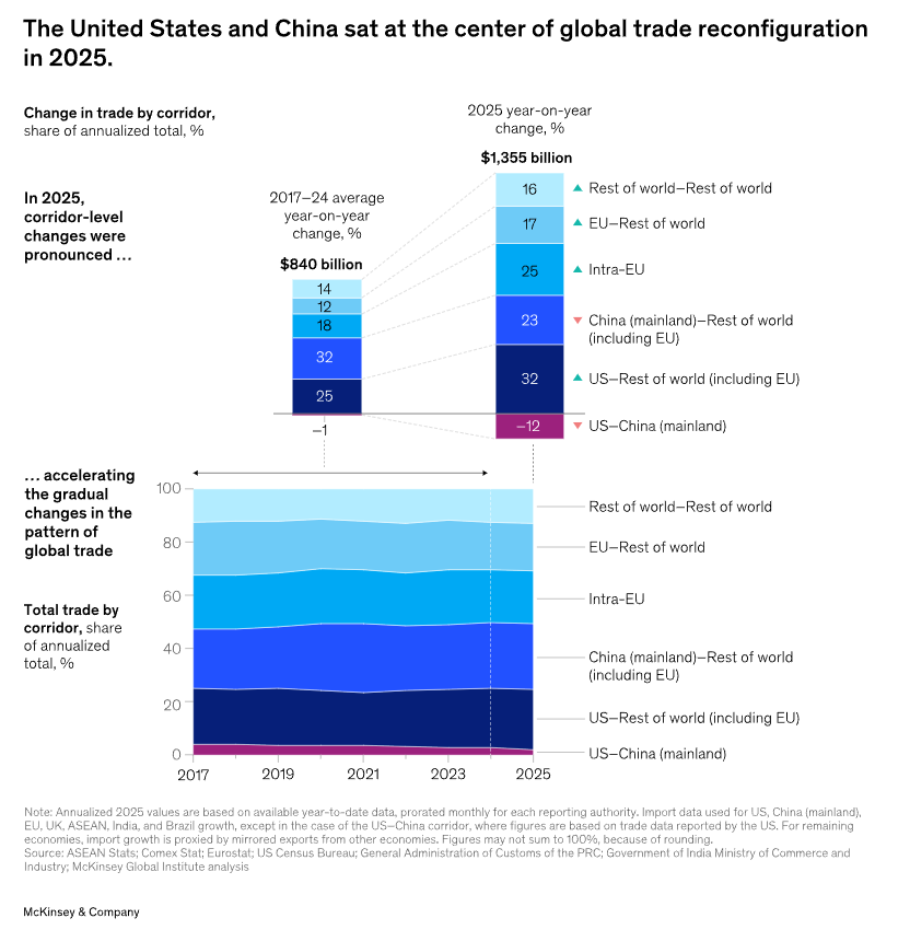
The numbers that procurement leaders watch most closely have quietly shifted. It’s not all about unit cost, lead time, and on-time delivery. What grabs the eye now supplier concentration risk, geopolitical exposure, regulatory compliance, and the ability to absorb disruption without breaking. According to a 2026 McKinsey Global Institute analysis, global trade grew approximately 6.5 percent in nominal terms last year, even as the composition of that trade changed dramatically. The US-China trade corridor contracted sharply, shedding roughly $165 billion in bilateral volume. The gap was filled, in part, by India, ASEAN economies, and a reconfigured set of trusted partners.
India’s total exports stood at $795 billion in FY2025, with port throughput reaching 795 million tonnes and Dedicated Freight Corridors progressively commissioned across key industrial corridors, according to data from the Journal of Supply Chain. These are key signals of an economy building the physical architecture of a new supply chain geography.
The Pharma pivot
Nowhere is the strategic rethink more visible than in pharmaceuticals. India has long been the world’s pharmacy for generics. What is changing now is the nature of the demand, and the sophistication of the response.
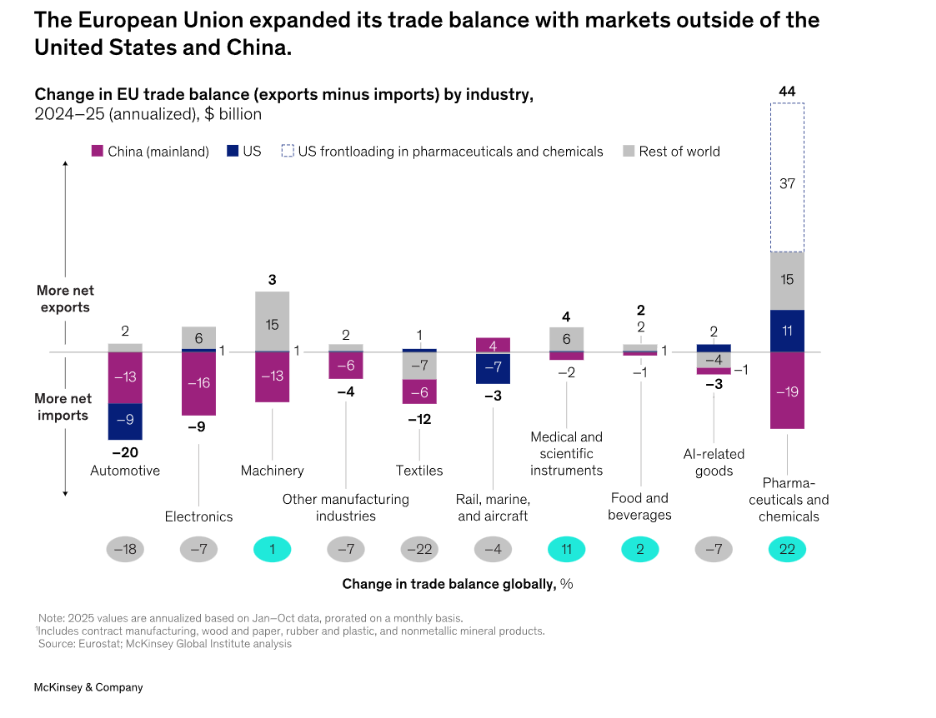
In July 2025, the United States confirmed it would impose a 15 percent tariff on branded medicines imported from Europe, according to reporting in Pharmaceutical Market Europe. That single policy decision sent procurement teams across the global pharma industry scrambling for alternatives. India, with cost advantages of up to 35 percent over US and European manufacturing, a robust ecosystem of contract manufacturing organisations (CMOs), and a track record of FDA-compliant production, was the natural beneficiary.
The global biopharmaceutical CMO market hit $19 billion in 2025 and is projected to grow at a compound annual growth rate of 15.3 percent through 2032, according to industry data. Indian CMOs are expanding their global footprint, building FDA-compliant facilities and offering end-to-end services that appeal to both startups and large multinationals.
For Indian pharmaceutical companies themselves, the resilience imperative has driven internal change as well. Serum Institute of India diversified its supply base for vials, stoppers, and cold-chain logistics to prevent single points of failure in mass-scale vaccine manufacturing. Dr. Reddy’s Laboratories accelerated digital procurement to increase transparency and responsiveness in purchasing, according to Mondaq’s analysis of procurement transformation in the Indian pharma sector.
The three new rules of the world order
The companies building durable supply chains in this environment are operating by a fundamentally different set of principles.
The first is diversification over optimisation. The instinct to concentrate sourcing with a single low-cost supplier has given way to a portfolio approach: multiple geographies, multiple suppliers, explicit redundancy built into the system. The cost of that redundancy is treated as an insurance premium, not a waste. According to supply chain consultancy Velox Consultants, Indian enterprises are now building landed-cost simulation frameworks that test profitability under various tariff scenarios, going so far as to integrate geopolitical intelligence into pricing strategy proactively rather than reactively.
The second is compliance as competitive advantage. Developed markets, particularly the United States and the European Union, are enforcing increasingly stringent quality, data integrity, and cybersecurity standards across their supply chains. Indian manufacturers that invest in compliance infrastructure are discovering that meeting those standards is a form of differentiation that competitors who cut corners cannot easily replicate.
The third is technology as connective tissue. Blockchain traceability, digital twins of supply chains, AI-driven demand forecasting, and real-time logistics monitoring are moving from experimental to operational. According to a NASSCOM analysis, digital technologies are projected to account for 40 percent of total manufacturing spend in India by 2025, up from 20 percent in 2021. The companies that have made that investment are discovering they can absorb disruptions that would have paralysed their competitors.
What lies in the decade ahead
India’s position in the new supply chain geography is neither guaranteed nor yet fully realised. The country’s export growth in 2025 was ultimately flat in aggregate, with gains in electronics and pharmaceuticals offset by declines in petroleum and chemicals. The infrastructure, regulatory agility, and manufacturing depth required to become the next great export economy are still being built.
But the structural forces are aligned in India’s favour in a way they have not been in a generation. The China-plus-one strategy has moved from a contingency into a standing operating procedure for multinationals across sectors. The US-India trade relationship is deepening. PLI schemes are beginning to show results in sectors from semiconductors to specialty chemicals.
The supply chain of the next decade will be built on a different logic to that seen in the last 30 years. It will call for a particularly modern set of values: trust, resilience, and the ability to prove, repeatedly, that you can deliver when it matters most. India, if it executes well, is better placed than almost anywhere else to meet that brief.