


Words by Anita Shukla
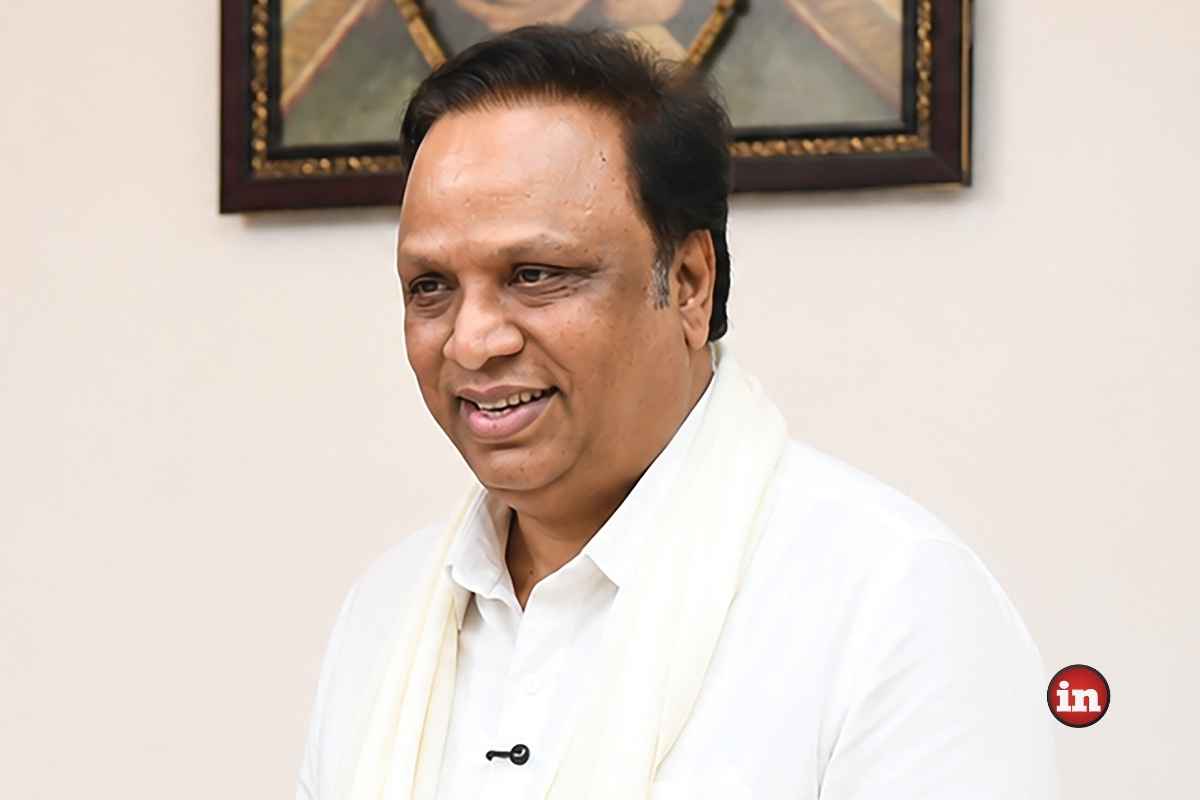
Ashish Shelar wears several hats, and does so comfortably. Besides being the Cabinet Minister for Electronics, IT, AI and Cultural Affairs in the Government of Maharashtra and a 3-time MLA from Vandre West, he is a lawyer by training, a reader by temperament, and a politician by conviction. In a candid conversation that moves from infrastructure to identity, from Mumbai’s frustrations to India’s future, he offers a portrait of public life that is quieter, and more considered, than the headlines typically allow.

There is a version of the politician that the public has come to expect. Loud, combative, perpetually in campaign mode. Ashish Shelar, Cabinet Minister for Electronics, IT, AI and Cultural Affairs in the Government of Maharashtra, does not quite fit that mould, and he is aware of it.
“Many people see only the political side of me,” he says, “and assume I am always in political mode. In reality, I am deeply interested in culture, literature, technology, sports and public administration. Politics is only one part of my life.” He is a lawyer by training, a criminal practitioner specifically, and is currently contemplating writing a book. It is, in some ways, an unusual self-portrait for someone in the middle of one of Maharashtra’s most consequential ministerial portfolios.
But the depth of interest he describes is not performative. When he talks about Mumbai, the frustration is genuine and specific. “What frustrated me was that for decades its infrastructure did not keep pace with its aspirations,” he says. The city, in his telling, has always deserved better; better transport, better systems, better correspondence between its extraordinary economic contribution and the physical experience of living in it. He looks to Singapore for efficiency, Tokyo for its transport architecture, and London for how it has conserved heritage without surrendering momentum. But he is careful to add that Mumbai’s energy and resilience are, in the end, unmatched. The lesson is to selectively borrow from the world.
On the question of governance itself, Shelar is most animated, and most direct. “Every delayed decision affects someone’s life,” he says. “Whether it is a student, an entrepreneur, an artist or an ordinary citizen, governance is ultimately about people, not files.” It is the kind of line that could sound like a slogan, but in context it reads more like a discipline, and is a standard he applies to himself. He cites, as he does repeatedly, the example of Prime Minister Narendra Modi and Chief Minister Devendra Fadnavis, specifically their relentless orientation toward outcomes rather than intentions.
That orientation is visible in the portfolio he oversees. Maharashtra, under his ministry, is building toward an AI policy that spans socio-economic sectors, repeal of nearly 80 obsolete laws that had become governance obstacles, and digital public service infrastructure aimed at reducing the friction between citizen and state. The ambition is end-to-end digital accountability, a system in which every public service, every project, and every rupee spent is visible, trackable, and measurable in real time. “That is the direction I would move in even faster,” he says, “if there were no constraints at all.”
On the question of young people and political life, he is thoughtful. Too many young Indians, he argues, see politics only through its most visible and least flattering expressions. They see elections and controversy, not the quieter levers of public administration that actually shape lives. “Public life can be a powerful instrument of nation-building,” he says. “I think more young Indians should see politics through that lens.”
As for legacy, he is refreshingly unbothered. “I do not aspire to be remembered,” he says. “Public life is about serving people, not creating a legacy for oneself.” If history does take note, he hopes it is for sincerity, compassion, and integrity, not the scale of ambition, but the quality of presence.
In a political culture that often rewards volume over substance, it is a quietly distinctive position to hold.